
How Do Health Coverage Costs Work Together?
How premiums, deductibles, copays, coinsurance, and out-of-pocket limits fit together.
Health coverage costs are easier to understand when you see them as parts of one system. This module walks through the main cost-sharing terms and shows how they can work together in a simple, fictional example.
The five terms to know
Most health plans use several types of costs. Each one works a little differently:
- Premium — the amount paid to keep the health coverage active, often monthly. Learn more about premiums.
- Deductible — an amount you may need to pay toward certain covered services before the plan begins paying its share for those services. Learn more about deductibles.
- Copay — a fixed amount that may apply to certain covered services, such as a visit or a prescription.
- Coinsurance — a percentage of the allowed cost of a covered service that you may pay. Learn more about copays and coinsurance.
- Out-of-pocket maximum — an annual limit on applicable cost-sharing for covered in-network services. Learn more about out-of-pocket maximums.
Two kinds of costs: keeping coverage vs. using care
It can help to separate costs into two groups:
- The cost of having coverage — the premium. It is usually paid whether or not you use medical care.
- The cost of using care — deductibles, copays, and coinsurance. These are often called cost-sharing, because you and the plan share the cost of covered services.
Looking at only one number, such as the premium, may not show the full picture of what health coverage could cost over a year.
How they can work in order
For many plans, a typical sequence for covered services looks like this:
- You pay the premium to keep coverage active.
- For services that are subject to the deductible, you may pay the allowed amount until the deductible is met.
- After the deductible is met, you may pay copays or coinsurance while the plan pays the rest of the allowed amount.
- If your applicable cost-sharing reaches the out-of-pocket maximum, the plan generally pays 100% of covered in-network services for the rest of the plan year.
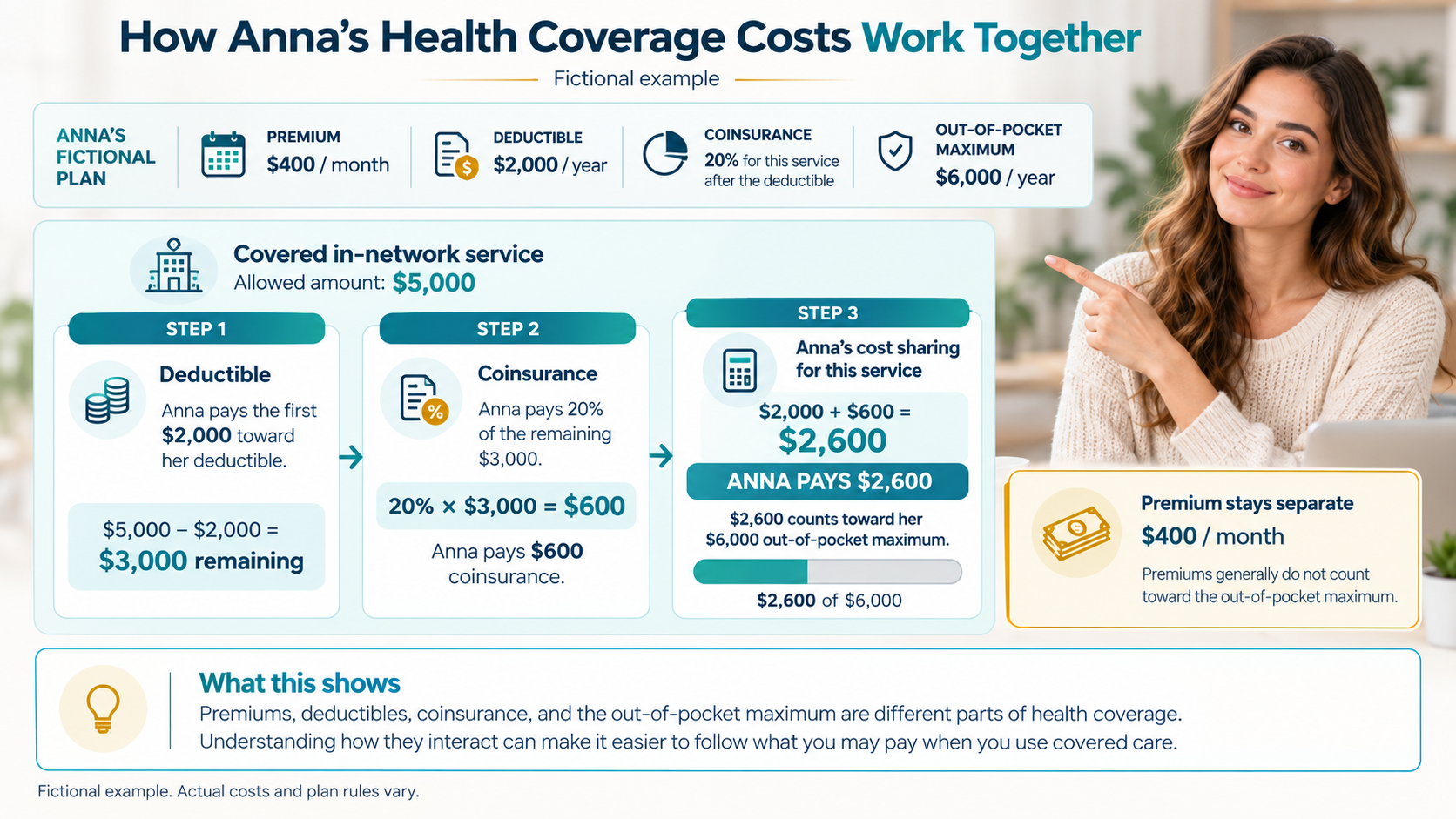
Real-Life Example: How Anna’s Costs Work Together (fictional example)
Anna has a fictional health plan with:
- $400 monthly premium
- $2,000 annual deductible
- 20% coinsurance for this covered service after the deductible
- $6,000 annual out-of-pocket maximum
Anna receives a covered in-network outpatient service with an allowed amount of $5,000. Under this fictional example, she has not yet paid anything toward her deductible for the year.
Step 1 – Deductible
Anna pays the first $2,000 toward her deductible.
Step 2 – Coinsurance
That leaves $3,000 of the allowed amount. Her 20% coinsurance is:
20% × $3,000 = $600
Step 3 – Anna’s cost sharing for this service
$2,000 + $600 = $2,600
The $2,600 counts toward her fictional plan’s $6,000 out-of-pocket maximum.
Her $400 monthly premium is separate and generally does not count toward the out-of-pocket maximum.
What this shows: Premiums, deductibles, coinsurance, and the out-of-pocket maximum are different parts of health coverage. Understanding how they interact can make it easier to follow what you may pay when you use covered care.
Key takeaways
- Premiums pay for having coverage; deductibles, copays, and coinsurance are costs of using care.
- Cost-sharing terms often work in sequence, but the order and applicability depend on plan rules.
- Looking at one number alone may not show the full yearly cost.
- Always verify details in your specific plan documents.
Educational information only. Examples are fictional and do not describe any real insurer or plan. Health-plan terms and requirements vary — always verify information using your official plan documents. Read the disclaimer.