
Understanding Your EOB
How to read an Explanation of Benefits — and why it is not a bill.
After you receive care, your health plan may send you an Explanation of Benefits (EOB). It shows how a claim was processed. This module explains the main parts and how to use them.
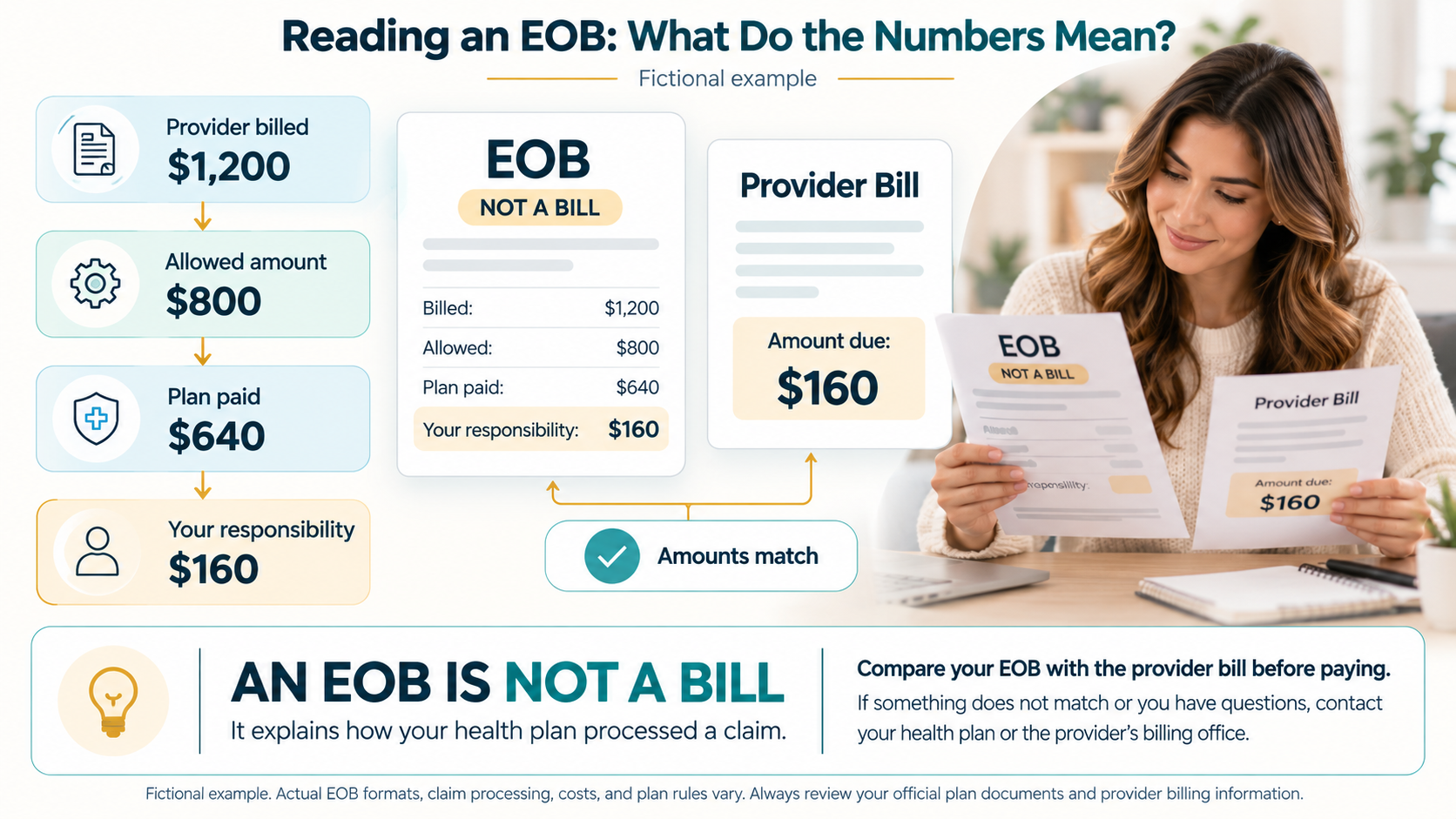
An EOB is not a bill
The main parts of an EOB
- Claim
- A request for payment sent to the plan for services you received.
- Amount billed
- The amount the provider charged for the service.
- Allowed amount
- The amount the plan recognizes for a covered service. For in-network providers, this is usually the negotiated rate.
- Plan payment
- The amount the plan paid toward the allowed amount.
- Member responsibility
- The amount you may owe, such as deductible, copay, or coinsurance, and any amount not covered.
Compare before you pay
When a bill arrives from a provider, it can help to compare it with the EOB for the same service:
- Do the dates of service and provider name match?
- Does the amount on the bill match the member responsibility on the EOB?
- Was the claim processed as in-network or out-of-network?
- Are there any denied services or notes you do not understand?
If something does not match, contact your plan or the provider’s billing office to ask questions.
Real-life example: Reading Anna’s EOB (fictional example)
| EOB line | Amount |
|---|---|
| Amount billed | $1,200 |
| Allowed amount | $800 |
| Plan payment | $640 |
| Member responsibility (20% coinsurance) | $160 |
Anna has already met her deductible. The in-network provider billed $1,200, but the allowed amount is $800. Her plan paid $640, and her coinsurance is $160. When the provider’s bill arrives, Anna checks that it asks for $160 and matches the EOB before paying.
Key takeaways
- An EOB explains how a claim was processed. It is not a bill.
- Key lines: amount billed, allowed amount, plan payment, and member responsibility.
- Compare provider bills with the EOB and ask your plan or provider about differences.
Educational information only. Examples are fictional and do not describe any real insurer or plan. Health-plan terms and requirements vary — always verify information using your official plan documents. Read the disclaimer.